
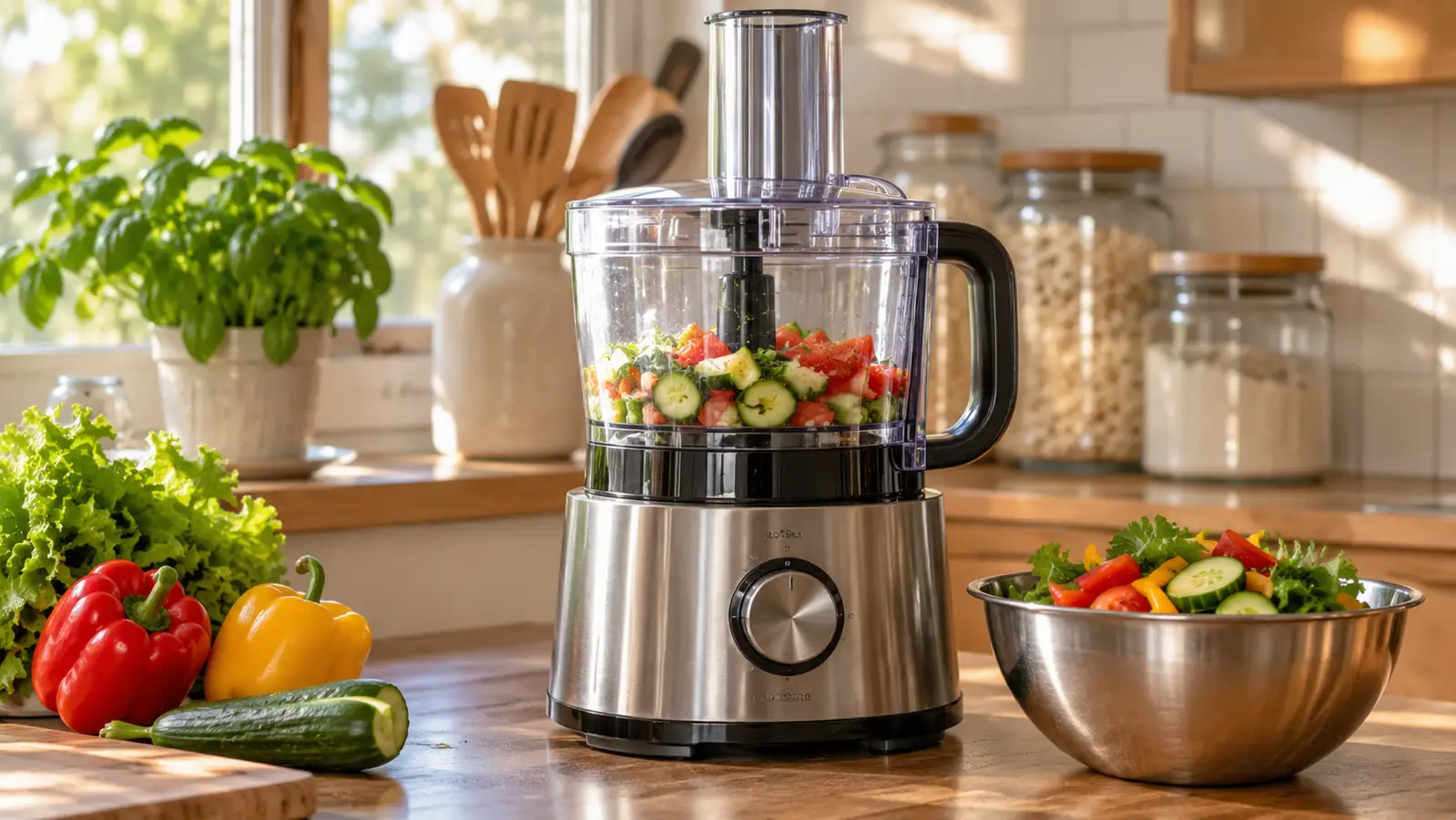
I bought this Cuisinart food processor for one reason: a 28-pound beagle mix named Biscuit who decided, at age nine, that he would rather skip dinner than eat kibble. After a run of upset stomachs and three different vet visits, I started cooking his food myself on Sunday afternoons. That first week, I chopped sweet potatoes, zucchini, and green beans by hand, and I stood at the counter for close to an hour with a knife and a sore wrist. By the third Sunday, I had ordered the Cuisinart 14-cup food processor, and it has been on my counter ever since.
This is not a lab test. This is one retired school cafeteria manager, her ordinary Madison kitchen, one chest freezer in the garage, and a dog with a sensitive stomach. I have used this machine almost every week for over a year, and I want to tell you exactly what that looks like, because most food processor reviews are written for people making hummus, not people making a week of dog food.
The Quick Verdict
If you batch-cook for a dog, this is the machine I'd buy again. It is heavy, it is loud, and it takes up counter space, but it has turned my Sunday chopping from forty minutes into eight, and it has never once let me down.
Amazon Check Today's Price →The 14-cup workhorse that ended my Sunday chopping marathon
If you're cooking for a sensitive-stomach dog, the Cuisinart 14-cup food processor is the one I reach for every single week. Check today's price on Amazon.
Amazon Check Today's Price on Amazon →How I've Used It
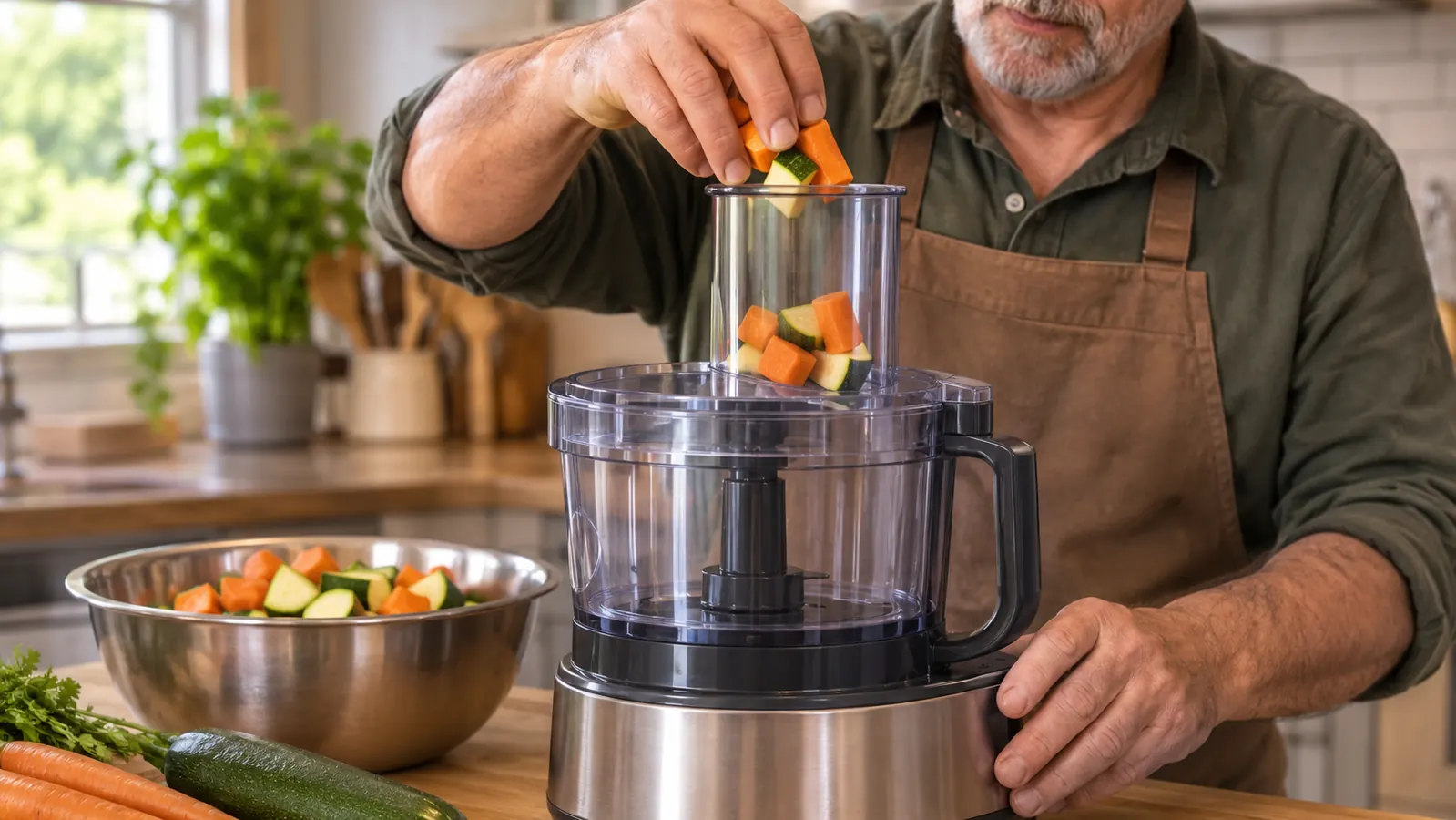
Every Sunday, I make a week of food for Biscuit. That means about six cups of chopped vegetables, a pound of cooked protein, and a grain, all mixed together and portioned into freezer bags. Before the Cuisinart, that was the worst part of my week. Sweet potatoes are hard, and my hands are not as young as they used to be. Now I drop the chunks into the feed tube, press pulse a few times, and move on to the next vegetable.
The 14-cup bowl is the reason I chose this model. I can chop the whole week's vegetables in two batches instead of four. The extra-large feed tube means I do not have to pre-cut a sweet potato into tiny sticks; I cut it into chunks that fit, and the machine does the rest. The on and off/pulse buttons are simple, and after a year I still use pulse more than anything else, because a few short pulses give me chopped vegetables, and a longer run gives me puree for the days Biscuit's stomach is acting up.
I also use the included slicing disc and shredding disc more than I expected. The 4mm slicing disc makes quick work of zucchini, and the medium shredding disc handles carrots and sweet potatoes. Everything that touches food goes into the dishwasher, which matters more than you might think when you are cooking for a dog with a sensitive stomach. I do not want to hand-wash a greasy processor bowl on a Sunday night.
The first Sunday with the Cuisinart, I timed myself. From the moment I pulled the sweet potatoes out of the bin to the moment the last freezer bag went into the chest freezer in the garage, it took twenty-two minutes. The Sunday before, the same job had taken me close to an hour, and I had stopped twice to stretch my wrist. The difference was not just the chopping. It was that I could do the whole job in one place, without juggling a knife, a board, and a compost bowl. I now chop the sweet potatoes first, then the zucchini, then the green beans, and by the time the cooked protein has cooled enough to handle, every vegetable is already in the mixing bowl. That rhythm is why I have kept this up for over a year instead of quitting in March like I did the last time I tried homemade dog food.
What the Specs Actually Mean in a Dog Kitchen
The Cuisinart has a 720-watt motor, and that number stopped being abstract the first time I fed it a whole sweet potato. A weaker machine would stall and whine. This one just chops. The motor is what makes the difference between a food processor you use and a food processor you store in the back of a cabinet.
The motor matters most when the bowl is full. A half-full bowl of soft zucchini is easy for any machine. A two-thirds-full bowl of raw sweet potato cubes is a real test. I have watched this Cuisinart handle that load without slowing down, and I have also watched it do something my old processor could not: keep chopping when I added a handful of frozen green beans right on top. The pitch of the motor changes for a second, then it settles. That is the sound of a machine that has power in reserve.
The bowl capacity is 14 cups, which sounds like a lot until you are chopping a week of vegetables. I fill it about two-thirds full, pulse, and empty it. The included components are straightforward: a chopping blade for mincing and pureeing, a standard slicing disc, and a medium shredding disc. I use the chopping blade every single week, and the two discs most weeks.
The extra-large feed tube is the feature I did not expect to care about. My old food processor, a cheap model I bought in the 1990s, required me to cut a sweet potato into thin sticks before it would accept them, which meant I was still doing most of the knife work. With this Cuisinart, I cut sweet potatoes into quarters, drop them in, and pulse. The bowl sleeve assembly keeps everything from jumping around, and I never put a finger near the blade. For a person who spent decades in a school cafeteria, that is the kind of safety detail I notice and appreciate.
The machine is corded electric, which I consider a feature. I never worry about a battery dying halfway through a batch. It runs on standard 120 volts, so it works in any kitchen outlet. I have the machine positioned so the cord reaches the outlet behind the toaster without me moving anything. The item weight is 18 pounds, and that is the one spec I would tell you to take seriously. This is not a machine you lift over your head. It lives on my counter, and I am glad it does, because hauling it out of a cabinet every Sunday would probably mean I would not use it.
The dimensions are 11 inches deep, 7.9 inches wide, and 14.8 inches high. Measure your space under the upper cabinets before you buy. I have a standard counter, and it fits, but it is tall. If you have low cabinets, this might be the detail that decides for you.
How It Holds Up After a Year of Sunday Use
After roughly fifty batches, the motor still sounds the same as the day I bought it. The bowl has a few faint scratches from the chopping blade, but nothing that affects how it works. The discs are still sharp. The feed tube still locks in place with a satisfying click. I have not had a single part break, warp, or crack, and I have put this machine through the kind of weekly abuse that a person cooking for a dog does not apologize for.
I can date the machine's hardest test: the third Sunday in February, when I dropped a frozen sweet potato into the feed tube without thinking. It was rock hard, straight from the chest freezer, and I was sure I had just ruined the blade. The motor grunted once, then settled into its usual rhythm, and the sweet potato came out in rough chunks. I have not done that again, but knowing the machine can survive a mistake like that changes how I use it. I no longer treat it like something fragile. I also stopped worrying about the finish on the bowl. It has a few faint scratches from the blade, and they do not matter. The machine is a workhorse, not a showpiece.
The dishwasher-safe parts are the reason this routine has lasted. I can wash the bowl, lid, feed tube, and discs in the dishwasher, and they come out clean. That means the whole cleanup takes about two minutes. If I had to hand-wash everything, I would have started skipping Sundays by the second month.
The one thing I have learned is to read the manual before the first use. The manual is not a suggestion. I set mine up wrong the first time, the lid did not seat, and the machine would not start. Once I actually read the instructions, it has worked every single time. I also learned the order of assembly: bowl first, then lid, then feed tube. When I follow that order, the machine starts every time. When I rush and try to skip a step, it lets me know. That is not a flaw in the machine; it is a reminder that a food processor is a tool with a specific way of being assembled.
Fifty Sunday batches in, the motor sounds exactly like it did on day one, and the dishwasher-safe parts are the reason I still cook for Biscuit instead of giving up.

The Tradeoffs Nobody Mentions
Let me be honest about the downsides, because you deserve them before you spend money. First, this machine is loud. It is not deafening, but it is not quiet, and my beagle mix leaves the kitchen when it runs. The first Sunday, Biscuit was asleep on the rug, and when the motor started he was across the room before I could blink. He now sleeps through it, but it took about a month. If you have a dog who is nervous about noise, run the machine a few times while the dog is in another room, then let the dog come in and sniff the bowl while the machine is off. It sounds like a small thing, but it is the difference between a dog who hides and a dog who naps through your prep.
Second, the 18-pound weight is real. I am a retired cafeteria manager, so I am used to heavy equipment, but if you have limited hand strength or limited counter space, this is a consideration. It is not a machine you want to move around. It wants to live in one spot.
Third, the manual operation is exactly what it sounds like. There is no timer, no sensor, no auto mode. You press on or off/pulse, and you watch the food. For a person who likes to set something and walk away, that is a drawback. For me, it is the point. I want to see the chop, stop when it looks right, and not trust a machine to decide when my dog's vegetables are done. The pulse button also gives me control over texture. Biscuit gets his zucchini chopped fine but his green beans chopped coarse, and I can do both in the same bowl by counting pulses: seven for fine, four for coarse. That is the kind of control a manual machine gives you, and it is why I have never wished for a fancier one.
Fourth, the 14-cup bowl is big. If you are cooking for a small dog or making a single batch of soup, you will be scraping food off the sides of a very large bowl. I use it for Biscuit's weekly batch, so the size works for me, but it is worth knowing before you buy. When I make a smaller batch, I pulse less and scrape the sides more, and it still works. The bowl is heavy when it is full, so I always set it on the counter before I empty it, never hold it over the mixing bowl with one hand.
What I Liked
- The 720-watt motor powers through hard vegetables like sweet potatoes without stalling
- The 14-cup bowl handles a full week of dog food in two batches
- The extra-large feed tube means less pre-chopping
- The bowl, lid, and discs are all dishwasher-safe, so cleanup takes minutes
- Simple on and off/pulse controls that are easy to use one-handed
- The included 4mm slicing disc and medium shredding disc are genuinely useful
Where It Falls Short
- It is heavy at 18 pounds, so it is not a machine you want to move around
- It is loud, and some pets will leave the room
- It is manual only, with no timer or sensor, so you have to watch it
- The 14-cup bowl is large for small batches
- It takes up permanent counter space, so measure your kitchen first
Who This Is For
This Cuisinart is for you if you are already committed to cooking some or all of your dog's food at home, or if you have been thinking about it but the prep time is what stops you. It is for the person who wants to chop a week of vegetables in ten minutes instead of forty. It is for the person who has a picky eater, a dog with a sensitive stomach, or an older dog who needs a softer, home-cooked meal. It is for the person who wants a machine that will still be running a year from now.
It is also for you if you already own a blender and you are frustrated by how badly it handles dry or fibrous vegetables. I have a blender, and I know exactly why it is not the right tool. A blender needs liquid to move food around, so you end up with soup when you wanted chunks. A food processor gives you pieces you can see and control. Those are different jobs, and if you are making dog food, you need the chopping job done well.
Who Should Skip It
Skip this Cuisinart if you are not sure you will keep cooking for your dog. It is an investment, and it takes up real counter space. If you are still in the maybe phase, start with a sharp knife and a cutting board, and upgrade once you know the routine is going to stick. There is no shame in that.
Skip it if you have very limited hand strength, because the 18-pound weight and the need to lock the lid into place might be genuinely difficult. And skip it if you want a machine that does the thinking for you. This is a manual food processor. You press the button, you watch the food, and you stop when it looks right. Some people love that. Some people want a machine with more automation, and for them this is not the right fit.
Finally, if your dog is a puppy or a small breed and you are only cooking a cup of food at a time, the 14-cup bowl will feel enormous. A smaller model would probably serve you better.
Still chopping by hand every Sunday?
The Cuisinart 14-cup food processor turned my weekly dog food prep from a chore into a ten-minute task. See today's price on Amazon and decide for yourself.
Amazon Check Today's Price on Amazon →