
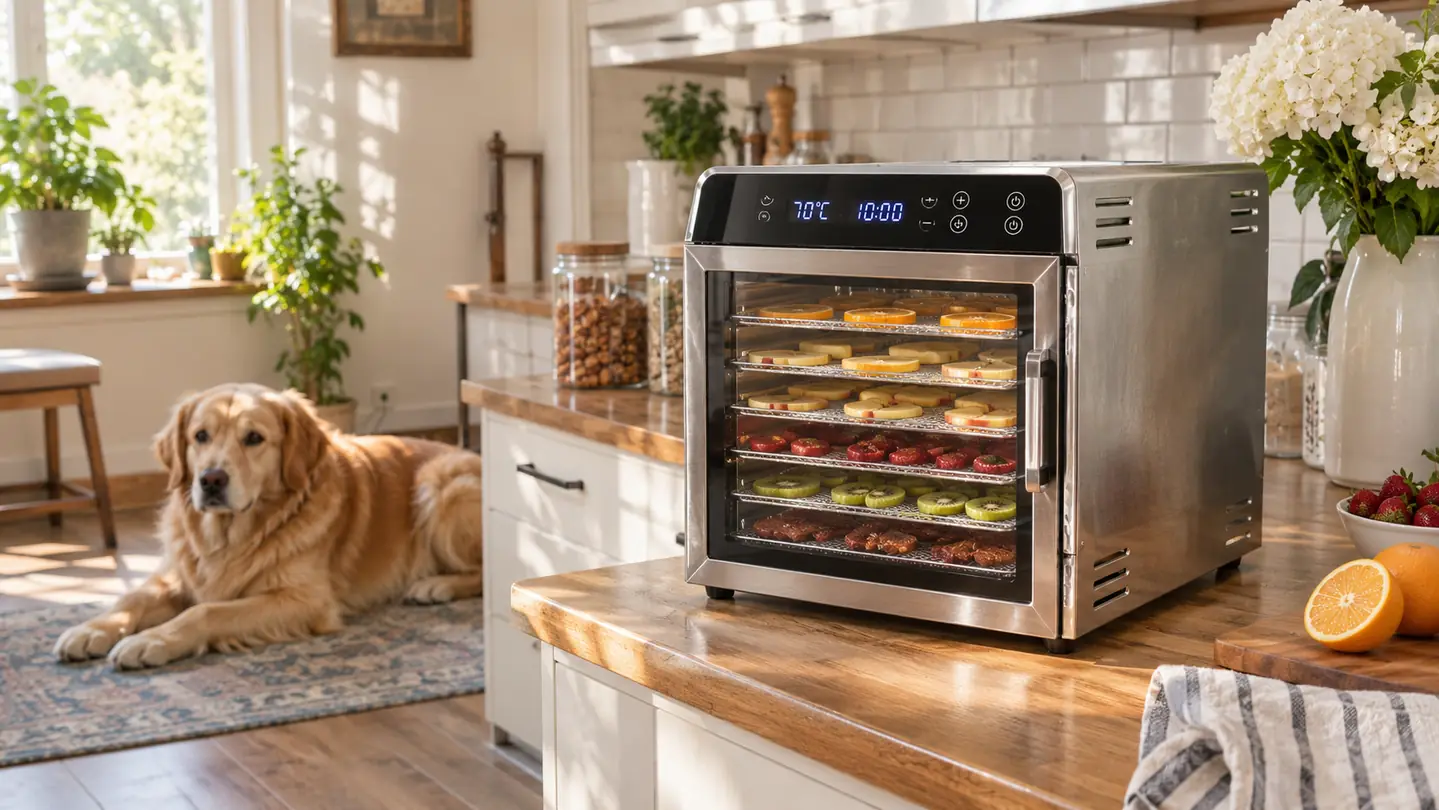
Biscuit is a nine-year-old beagle mix with a sensitive stomach and strong opinions about what he will and will not eat. He will walk away from a bowl of kibble, but a bag of store-bought treats with a label full of words I cannot pronounce? He never turned one down. After a few runs of upset stomachs that I could not trace to anything else, I started reading pet treat labels the way I used to read cafeteria ingredient lists, and I did not like what I found.
So I started making treats at home. My first attempts came out of the oven uneven, scorched at the edges, and soft again within three days. Then a neighbor who batch-cooks for her own dog loaned me her Cosori food dehydrator for a weekend, and the difference was immediate. The machine dries food slowly at a low temperature instead of baking it, which keeps the meat chewy and the nutrients gentle. I bought my own Cosori with six stainless steel trays a few weeks later, and it has been running on Sunday afternoons ever since.
The dehydrator I reach for every Sunday
Six stainless steel trays, 6.5 square feet of drying space, and a rear-mounted fan that dries evenly without rotating the trays. If you are going to make treats for a sensitive stomach, this is the machine I would start with.
Amazon Check Today's Price on Amazon →Before You Start: What I Use and Why
Here is the honest part. You do not need a fancy dehydrator to make dog treats. You need something that holds a low temperature, moves air around, and does not get so hot that it cooks the meat instead of drying it. The Cosori checks those boxes for me. It is a rectangular stainless steel machine with six trays and a 600 watt motor, which is plenty for a single dog and a weekly batch.
Two details sold me on it. The first is the rear-mounted drying fan, which moves air across every tray so I do not have to rotate them halfway through. The second is the noise level. The brushless motor stays below 48 decibels, which means I can leave it running on the counter overnight without the whole kitchen humming. It weighs about 18 pounds and takes up a corner of the counter, so it is not a gadget I have to dig out of a cabinet. It lives on the counter.
One more thing before recipes. I am a retired school cafeteria manager, not a vet. Everything I feed Biscuit gets a quick check-in with our vet, especially the first time I introduce a new ingredient. Please do the same. What works for a healthy adult dog may not work for a puppy, a senior, or a dog with a medical condition.
The Basic Recipe I Keep Coming Back To
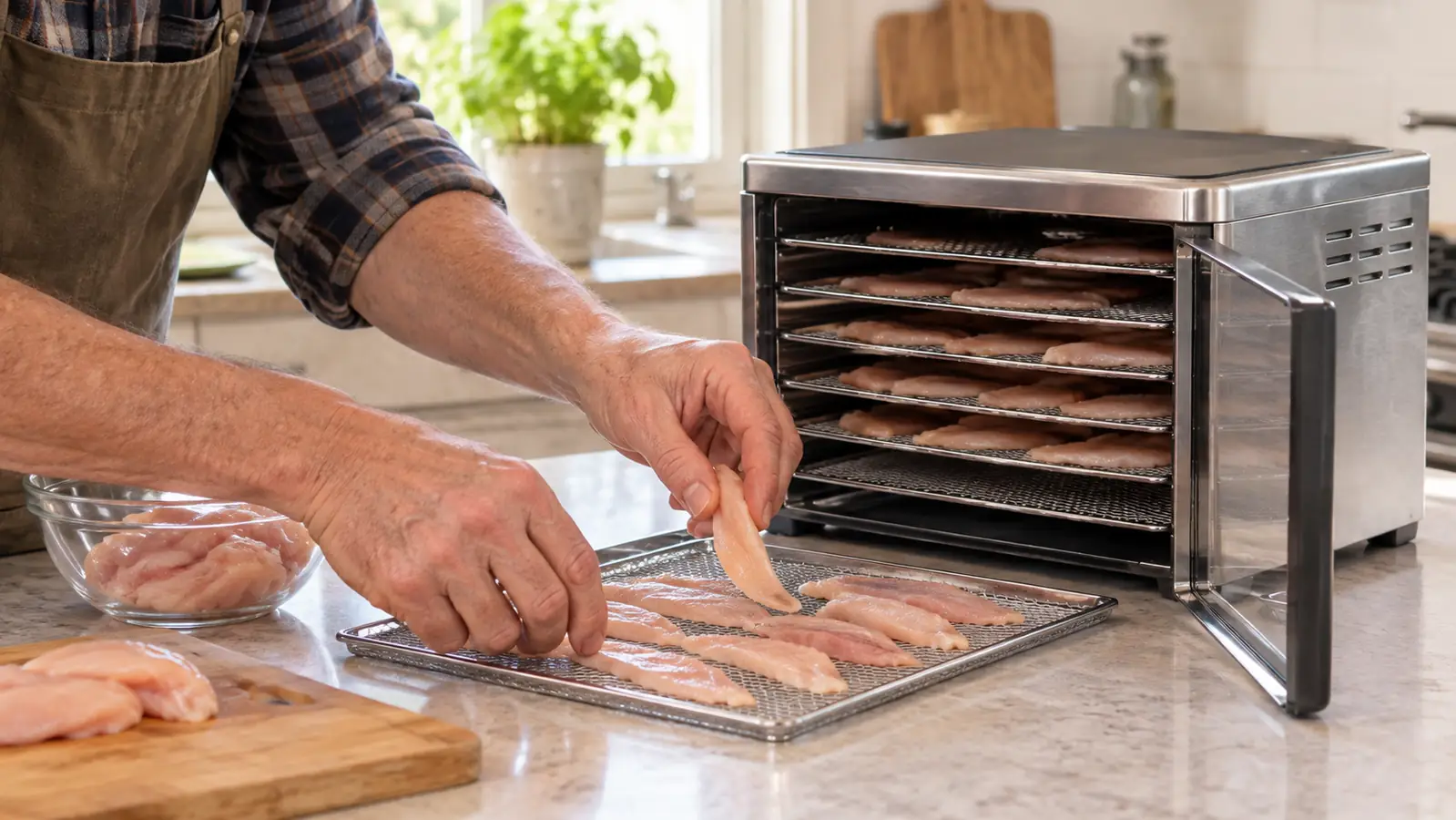
My default batch is chicken breast and sweet potato, two ingredients that are gentle on Biscuit's stomach and easy to find. I make about a week's worth of treats at a time, which for us is one full batch on the six trays. The recipe itself is simple: one pound of chicken breast, one medium sweet potato, and nothing else. No salt, no oil, no onion, no garlic. Dogs do not need the extras, and some of them are genuinely harmful.
I will say the obvious thing here, because it matters. Plain cooked chicken breast and plain cooked sweet potato are not a complete diet. These are treats, not meals. Biscuit still gets his regular food, and the treats are a small part of his day. If you are thinking about cooking all of your dog's meals at home, that is a bigger conversation to have with your vet, and it is not one I can settle for you in a recipe article.
Step 1: Prep the Meat and Produce
I start by trimming the chicken breast of any visible fat and cutting it into pieces that will slice evenly later. Then I wash the sweet potato well and scrub the skin. I leave the skin on, because it is where a lot of the fiber lives, but I am careful to get every bit of dirt off it first.
The single most important thing at this stage is cleanliness. I am handling raw poultry in the same kitchen where I cook for myself, so I use a separate cutting board, wash my hands constantly, and wipe down the counters with hot soapy water before anything else touches them. The same rules that kept a school cafeteria kitchen safe apply at home.
If your dog has never had sweet potato, introduce it slowly, a tiny piece mixed into his regular food, and watch for any reaction before you dehydrate a whole batch. Biscuit was fine, but every dog is different, and a wasted batch of treats is cheaper than a sick dog.
Step 2: Slice Thin and Even
Even slices are the whole game in dehydrating. A slice that is twice as thick in the middle as it is at the edge will dry unevenly, which means you either over-dry the edges or under-dry the center. I aim for strips about a quarter of an inch thick, and I try to keep them consistent. A sharp knife helps. A mandoline helps more, if you are comfortable using one.
Why does thickness matter so much? Because the dehydrator works by pulling moisture out at a steady rate. The Cosori's airflow technology moves air across all six trays at once, but it cannot fix a batch where some pieces are twice as thick as the others. Consistent slices dry at the same speed, which means the whole batch finishes at the same time.
Step 3: Load the Trays Without Crowding
Here is the mistake almost everyone makes the first time, including me: piling the trays full because there is so much room. The six stainless steel trays give you 6.5 square feet of drying space, and it is tempting to use all of it. But air needs to move around each piece. If pieces are touching or overlapping, the spots underneath stay damp, and damp spots are where spoilage starts.
I leave a little space between pieces, and I arrange them in a single layer on each tray. It means I use fewer trays per batch than the machine could technically hold, but it also means every piece comes out dry all the way through. For a week's worth of treats for one dog, I usually fill three or four trays at a time.
Step 4: Set the Temperature and Let It Run
Here is where the machine earns its keep. I set the Cosori to 145 degrees Fahrenheit for chicken and sweet potato. That is warm enough to pull moisture out steadily, but low enough that the meat dries instead of baking. The temperature range on this machine runs from 95 to 165 degrees, which covers everything from delicate herbs to jerky.
Because the fan is rear-mounted and the airflow is even, I do not rotate the trays. I just set it and walk away. On a typical batch, I let it run for about six to eight hours, depending on how thick my slices came out. The brushless motor stays quiet enough that I can leave it running overnight and still hear the dog snoring from the other room.
One honest note: I do not time it to the minute. I check the pieces by hand, and I would tell anyone new to dehydrating to do the same. Every batch is a little different, and the thickness of your slices matters more than any clock.
Step 5: Test, Cool, and Store
The test is simple. A finished piece should be dry on the outside and bend without snapping, like a soft jerky, not crumble like a cracker. If it feels leathery and there is no dampness in the middle when you tear it open, it is done. If the center still feels moist, back on the tray it goes for another hour.
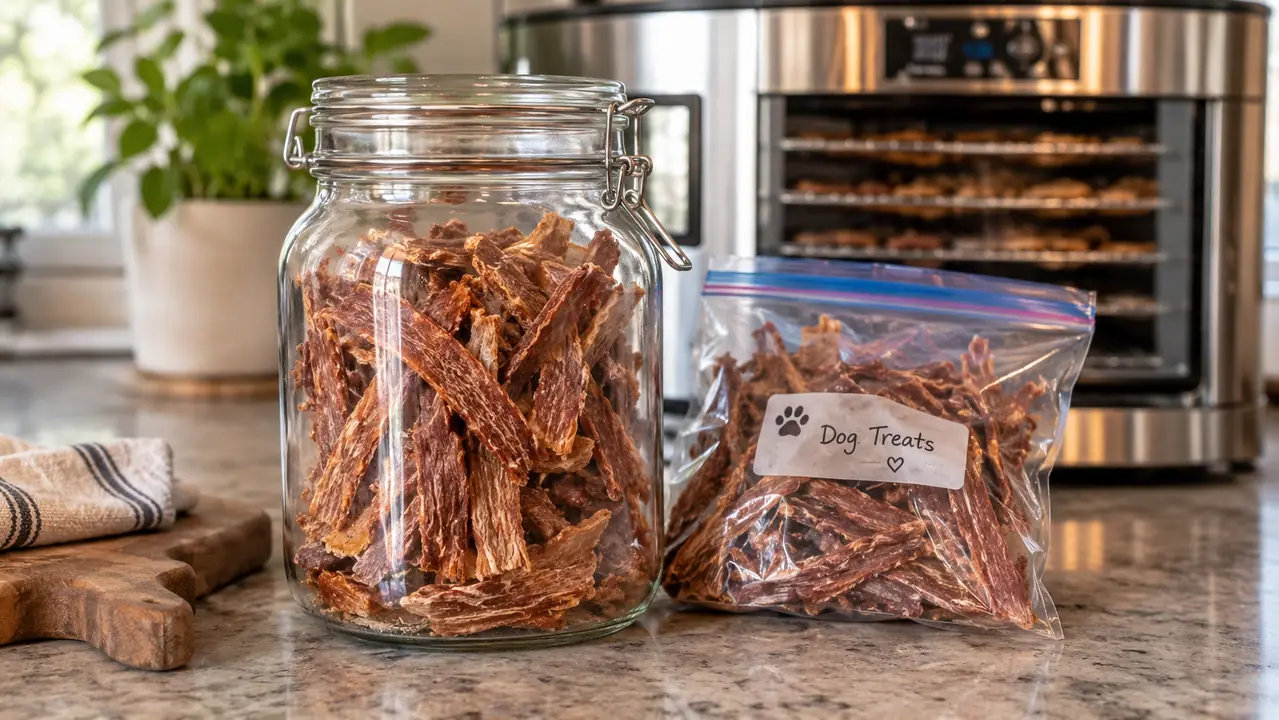
Let the treats cool completely on the counter before you store them. Warm treats trap condensation in whatever container you use, and condensation is how mold starts. Once they are cool, I keep a small jar in the kitchen for the next few days and put the rest in the freezer in the garage in labeled freezer bags.
Because these treats have no preservatives, the freezer is my storage answer. Frozen, they keep for a couple of months. In the fridge, I would use them within a week. At room temperature in a jar, I aim to use them within three or four days, and I check for any sign of mold before I give Biscuit one. When in doubt, throw it out. A treat is not worth a sick dog.
What Else Helps
A dehydrator is the centerpiece, but a few other things make the whole routine easier. A good chef's knife for even slicing, or a mandoline if you are confident with one. A digital kitchen scale, because consistent batch sizes mean consistent drying times. Freezer bags and a permanent marker, so I always know what is in the freezer and how old it is. And a notebook, honestly. I write down the date, the ingredients, the thickness, the temperature, and how long the batch took, so the next batch comes out better.
The mesh sheets that come with the machine matter too. The Cosori includes a fruit roll sheet and a mesh sheet in the box. For dog treats, the mesh sheet is the one I use most, because small pieces of sweet potato would otherwise fall through the tray gaps. I have also used the fruit roll sheet to make pureed treats for Biscuit when he was not feeling up to chewing.
One more thing that helps is a routine. I cook on Sunday afternoons, the same way I used to prep school lunches. The dehydrator runs while I do the rest of the week's cooking, and by evening the treats are cool enough to jar and freeze. A routine means I never have to think about whether the dog has treats, because they are always already made.
Six to eight hours at 145 degrees, and the motor stays quiet enough that I can leave it running overnight and still hear the dog snoring from the other room.
A Few Honest Tradeoffs
I want to be straight about the downsides, because every kitchen tool has them. Dehydrating is slow. A batch takes most of a day, even if most of that time is hands-off. The machine is also bulky. At about 18 pounds and 17.8 inches deep, it takes up a permanent spot on my counter, and I had to rearrange the kitchen to make room for it. And homemade treats do not last like store-bought ones. Without preservatives, you are on the hook for safe storage.
None of those tradeoffs made me put the machine away. The slow pace is fine because the machine does the work. The counter space is worth it because we use it every week. And the short shelf life just means I freeze in small batches, which I was going to do anyway. But I would rather tell you about the downsides now than have you discover them after you buy one.
The Bottom Line
If you have a dog with a sensitive stomach, a picky eater, or simply a dog whose treats you would rather be able to pronounce, a food dehydrator is a genuinely useful tool, and the Cosori is the one I would buy again. Six trays, even airflow, quiet enough to run overnight, and a temperature range that covers everything from fruit leather to jerky. I have made dozens of batches for Biscuit, and I have not bought a bag of commercial treats since.
Ready to start your own Sunday batch?
The Cosori food dehydrator with six stainless steel trays is the machine I use for every batch of Biscuit's treats. It dries evenly, runs quietly, and comes with a two-year manufacturer warranty.
Amazon Check Today's Price on Amazon →